


The Right Processor for the Right Workload: Engineering AI Computing Systems

The key to AI computing is no longer simply to select the most powerful processor. It is to understand which processing architecture is best suited to the workload. This means balancing performance, power consumption, latency and the requirements of the intended application.
As AI continues to evolve, we are seeing an increasingly diverse range of processors and specialized architectures designed to address different computing challenges. From large-scale AI training in data centers to real-time inference in embedded and edge devices, each processor architecture has its own strengths, limitations and ideal applications.
Understanding these technologies is becoming increasingly important when designing modern computing platforms and AI infrastructure.
Understanding the Different AI Processing Architectures
Let’s look at some of the key processor technologies shaping today’s computing landscape.
-
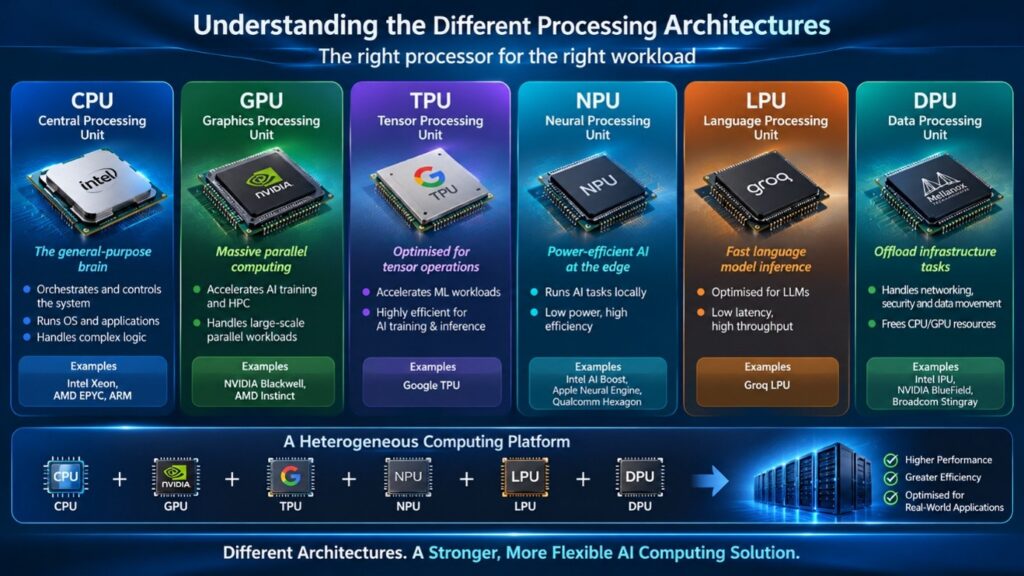
CPU – Central Processing Unit
The general-purpose brain of a computing system.
CPUs handle operating systems, applications, scheduling, orchestration and overall system control. They remain essential for coordinating workloads and managing the different components within a computing platform.
Examples: Intel® Xeon®, AMD EPYC and processors based on the ARM architecture.
-
GPU – Graphics Processing Unit
Originally developed for graphics processing, GPUs have become one of the most important technologies in modern AI and high-performance computing.
Their highly parallel architecture makes them particularly effective at handling large-scale mathematical operations required for AI model training, inference and scientific computing.
GPUs also play an important role in industrial and embedded AI applications, including machine vision, automated inspection and real-time sensor processing.
Examples: NVIDIA® Blackwell series, AMD Instinct series and GPU-accelerated embedded platforms such as NVIDIA® Jetson.
-
TPU – Tensor Processing Unit
A specialized processor architecture developed by Google to accelerate tensor operations and machine learning workloads.
TPUs are particularly suited to the mathematical operations used in neural networks. They demonstrate how dedicated silicon can be developed to optimize specific AI workloads..
Example: Google TPU.
-
NPU – Neural Processing Unit
NPUs are designed to accelerate AI-related operations efficiently, often with a strong focus on performance per watt.
They are increasingly integrated into PCs, smartphones and embedded devices, enabling AI capabilities to run locally rather than relying entirely on cloud-based processing.
This is particularly valuable in edge AI applications where power consumption, available space and network connectivity may be constrained.
Examples: Intel® AI Boost, Apple Neural Engine and Qualcomm Hexagon.
-
LPU – Language Processing Unit
A specialised architecture developed by Groq to accelerate large language model inference, with an emphasis on low latency and fast token generation.
Rather than targeting every type of computing workload, this approach focuses on making language model execution faster and more predictable.
Example: Groq LPU.
-
DPU – Data Processing Unit
DPUs are designed to offload infrastructure-related workloads from the CPU, including networking, security, storage and data movement.
By handling these tasks independently, DPUs can help improve overall system efficiency and allow CPUs and GPUs to concentrate on their primary workloads.
Examples: NVIDIA® BlueField, Intel® IPU, Broadcom Stingray and AMD Pensando.
Other technologies, such as Field-Programmable Gate Arrays (FPGAs), also play an important role in specialized computing applications, particularly where predictable latency and application-specific processing are required.
Why Are Hardware Companies Taking Different Approaches?
The growing diversity of processor architectures reflects a fundamental reality: there is no single processor architecture that is best for every AI workload.
Different companies are approaching the AI computing market from different directions:
- NVIDIA® is building a broad AI computing ecosystem, combining GPUs, networking, software and accelerated computing platforms.
- Google is developing specialized TPU architectures to optimize machine learning workloads across its infrastructure.
- Apple and Qualcomm are bringing AI processing closer to end users through power-efficient, on-device AI capabilities.
- Groq is focusing on low-latency inference for large language models.
- AMD is expanding its position across data center CPUs, GPUs and adaptive computing technologies.
- Intel® is combining general-purpose computing with integrated AI acceleration, supporting AI workloads across data center, industrial and edge computing platforms.
These strategies demonstrate that the future of AI computing is not necessarily about replacing one processor architecture with another. It is about combining different technologies to achieve the best overall result.
For system designers, the challenge is to balance computational performance, latency, power consumption, software compatibility and lifecycle requirements against the needs of the application.
The Future Is Heterogeneous Computing
From data centres and high-performance computing (HPC) to industrial PCs, embedded systems and edge AI, the future of computing will increasingly rely on heterogeneous architectures.
CPUs, GPUs, NPUs, TPUs, LPUs and DPUs will continue to evolve, with different combinations of these processors working together to deliver the right balance of performance, efficiency, latency, scalability and cost.
For those of us working in the computing industry, understanding these technologies is no longer simply a competitive advantage. It is becoming fundamental to how we design, build and deliver the next generation of computing solutions.
Ultimately, the question is no longer simply how powerful a processor is, but whether it is the right processor for the job.
Explore the Engineering Behind Edge AI
Discover how processor selection, power consumption and system integration influence real-world AI performance in our on-demand webinar, Engineering Edge AI: Performance, Power and Integration.
From AI Processor to Complete Computing System
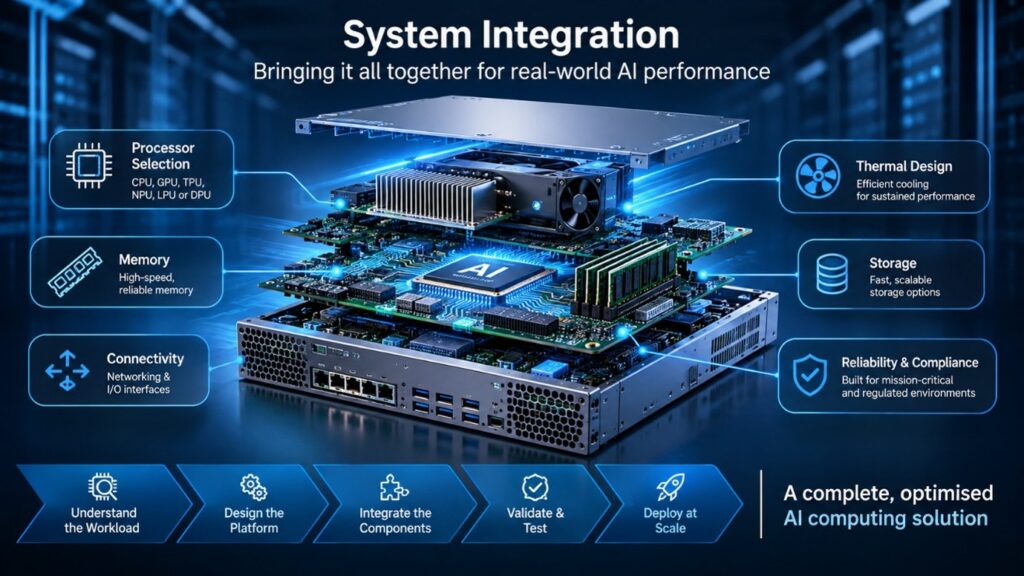
Selecting the right processor is only the beginning.
A processor may deliver exceptional performance in a benchmarking environment, but that performance must also be achievable within the power, thermal and environmental constraints of the deployed system.
A successful AI computing system requires several layers of engineering and integration:
-
Selecting the right AI processing technology
Understanding the workload, performance requirements, power consumption, cost, lifecycle requirements and software ecosystem before selecting the appropriate processor or accelerator.
-
Integrating it into a computing platform
Combining the AI accelerator with the appropriate CPU, memory, storage, networking and I/O architecture to create a balanced computing platform.
-
Developing the complete system
Addressing thermal management, power delivery, mechanical design, system reliability, scalability and manageability.
-
Integrating the solution for the end customer
Optimizing the complete platform around the customer’s application, operating environment and deployment requirements.
-
Meeting compliance and industry requirements
Ensuring the finished system meets the relevant regulatory, environmental, safety and industry-specific requirements for its intended market.
This is where specialist systems engineering and integration become increasingly important. A high-performance processor alone does not guarantee a successful product. The surrounding hardware, software, thermal design, mechanical architecture and application requirements all contribute to the final system.
This is particularly important in critical applications, where performance, reliability and compliance must be maintained throughout the system’s operational lifecycle
The Future Is Heterogeneous Computing
From data centers and high-performance computing (HPC) to industrial PCs, embedded systems and edge AI, the future of computing will increasingly rely on heterogeneous architectures.
CPUs, GPUs, NPUs, TPUs, LPUs and DPUs will continue to evolve, with different combinations of these processors working together to deliver the right balance of performance, efficiency, latency, scalability and cost.
For those of us working in the computing industry, understanding these technologies is no longer simply a competitive advantage. It is becoming fundamental to how we design, build and deliver the next generation of computing solutions.
Ultimately, the question is no longer simply how powerful a processor is, but whether it is the right processor for the job.
Explore the Engineering Behind Edge AI
Discover how processor selection, power consumption and system integration influence real-world AI performance in our on-demand webinar, Engineering Edge AI: Performance, Power and Integration.
Delivering end-to-end, like no one else.
Captec is an award-winning designer and end-to-end provider of specialized computing platforms, integrated systems and subsystems developed to support complex and demanding applications across a wide range of environments.
From modernizing existing technology platforms to integrating connected devices, edge computing and AI-enabled capabilities, Captec’s experienced teams help organizations evaluate, design and implement solutions aligned to their operational objectives.